The Dog Who Waited by the Gate Every Evening: A Rescue Story About Trust
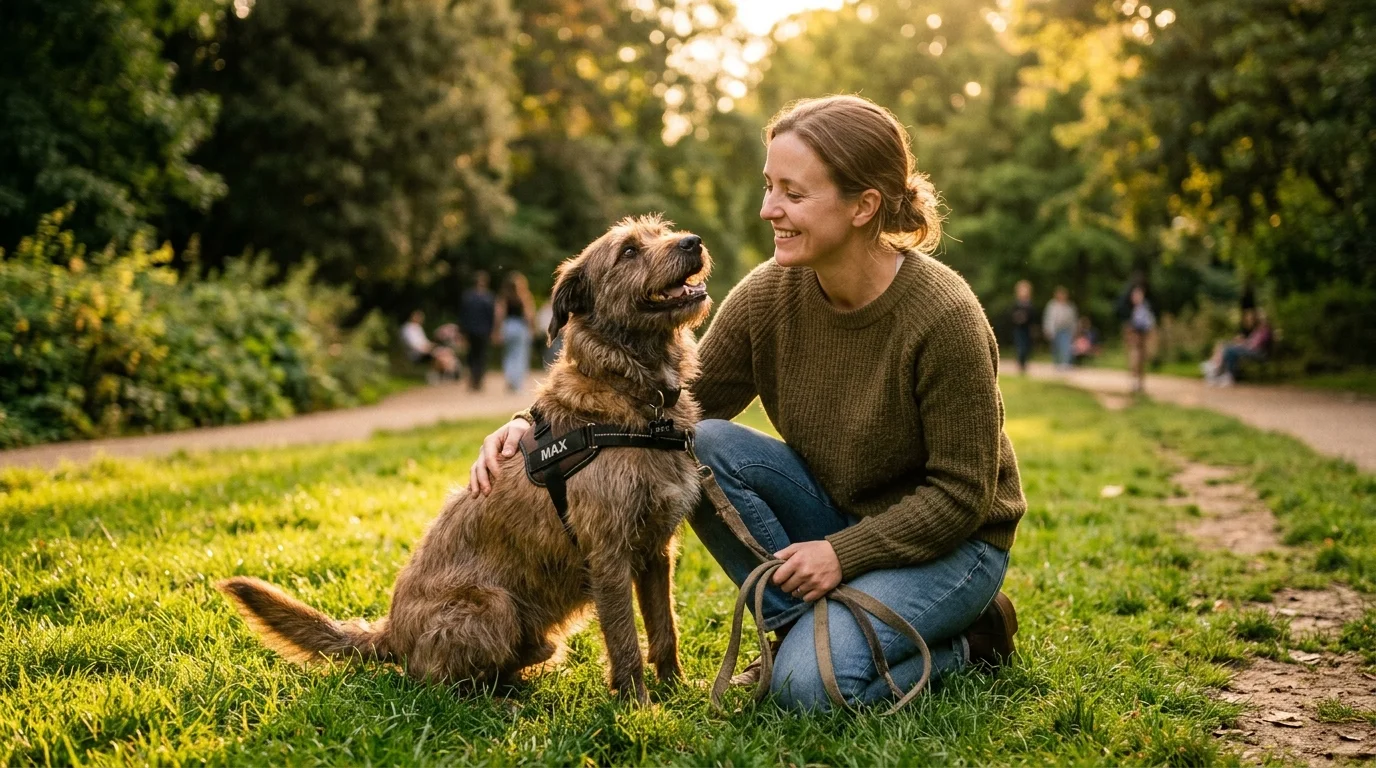
A gentle original Petzora story about a rescued dog who keeps returning to the front gate each evening, and the patient family who learns that trust cannot be rushed.
By Petzora Care Desk ·
Editorial note: This is an original Petzora fictional story inspired by common rescue and adoption experiences. The characters and events are fictional.
Every evening at six, Milo walked to the front gate and sat down.
He did not bark. He did not scratch at the wood. He simply watched the narrow strip of road beyond the fence as though he were waiting for someone who had promised to return.
For the first week, the Rahman family thought it was curiosity. Their new rescue dog was still learning the sounds of the neighborhood: bicycles clicking past the house, schoolchildren calling to one another, the vegetable seller pushing his cart along the road. But by the second week, the pattern was impossible to miss. At almost the same time every evening, Milo left whatever he was doing, walked to the gate, and waited.
A Dog Who Was Safe but Not Yet Home
Milo had arrived from a crowded shelter with a thin body, a faded red collar, and the habit of flinching whenever a door closed too quickly. The shelter had no complete history for him. They knew only that he had been found wandering near a bus stand and that nobody had come forward to claim him.
Inside the Rahman home, everything was ready. There was a soft bed near the living-room window, stainless-steel bowls, a basket of toys, and a quiet corner where he could retreat when the house felt too busy. The children had been told not to hug him, chase him, or crowd his space. They were excited, but they tried.
Milo accepted food politely. He allowed the leash to be clipped on. He slept through most nights. Yet he seemed to move through the house like a guest who expected to leave soon.
The Evening Ritual
At first, nine-year-old Sami tried to sit beside him at the gate. Milo stood and moved away. The next day, Sami brought a biscuit. Milo took it, carried it several steps away, and returned to the gate alone.
His mother, Farah, suggested a different approach: stop trying to interrupt the ritual.
So they let Milo wait.
They did not know what the gate meant to him. Perhaps it reminded him of a former home. Perhaps he had once been fed at that hour. Perhaps the road itself felt familiar. Or perhaps there was no dramatic explanation at all. Animals can build powerful routines around uncertain periods in their lives, and sometimes people never learn the exact reason.
What mattered was that Milo seemed to need the ritual.
Trust in Small Pieces
The family began measuring progress differently. They stopped asking, “Does he love us yet?” and started noticing smaller things.
On the tenth day, Milo slept with his back turned toward the room instead of facing the door. On the twelfth, he picked up a rope toy while Sami was sitting nearby. On the fifteenth, he followed Farah into the kitchen and lay down without being called.
None of these moments looked dramatic. There was no sudden transformation. But together they formed something more useful: evidence that Milo was beginning to feel safe.
The family kept his days predictable. Breakfast happened around the same time. Walks were calm and unhurried. Visitors were asked to ignore him until he chose to approach. When he retreated to his bed, nobody followed.
The First Rain
Three weeks after Milo arrived, heavy rain began just before six.
Farah expected him to skip the gate that evening. Instead, Milo walked to the covered porch and stared toward it from a distance. Water ran down the street. Motorbikes hissed through puddles. Thunder rolled somewhere far away.
He stood there for several minutes. Then he turned around.
For the first time, Milo did not wait at the gate. He walked back into the living room, circled his bed twice, and lay down beside Sami’s chair.
Sami looked at his mother, but she quietly shook her head. Let him choose.
The Gate Slowly Lost Its Power
Milo still returned to the gate on some evenings. But the visits became shorter. Ten minutes became five. Five became two. Sometimes he walked there, sniffed the air, and came straight back.
One evening, nearly two months after his adoption, six o’clock arrived while Milo was asleep under the dining table. Nobody mentioned the time. Nobody woke him.
He slept through the hour completely.
What the Family Learned
The Rahmans had imagined that rescuing a dog meant giving him food, shelter, affection, and safety. Milo taught them that belonging was more complicated. A home could be safe before it felt familiar. A family could be kind before it felt trustworthy. Love could be present long before an anxious animal was ready to believe in it.
They also learned that progress was not a straight line. After a noisy holiday weekend, Milo returned to the gate for several evenings. When a delivery worker dropped a metal box near the porch, Milo spent the rest of the day under the table. The family did not treat these setbacks as failure. They returned to routine and gave him space.
A Different Kind of Welcome
By the beginning of winter, Milo had developed new rituals. At breakfast, he waited beside the refrigerator. In the afternoon, he slept in a patch of sunlight near the stairs. When Sami came home from school, Milo met him halfway down the hallway, tail moving in wide, careful sweeps.
The front gate was still there, of course. It opened and closed every day. But it was no longer the center of Milo’s world.
One evening, Farah found him in the garden while the sky turned orange. Six o’clock had already passed. Milo was lying on his side with one paw resting on Sami’s shoe.
For months, Milo had watched the road as if home might be somewhere beyond it. Now he was no longer watching the road.
The Quiet Lesson
Rescue stories are often told as if the person saves the animal in a single moment. In reality, trust is usually built through repetition: meals delivered on time, doors that do not slam, hands that do not grab, walks that end safely, and people who keep returning tomorrow.
Milo’s family never discovered exactly why he waited at the gate. Eventually, they realized they did not need to.
The important part of the story was not who he had been waiting for. It was the day he finally understood that he no longer had to wait.