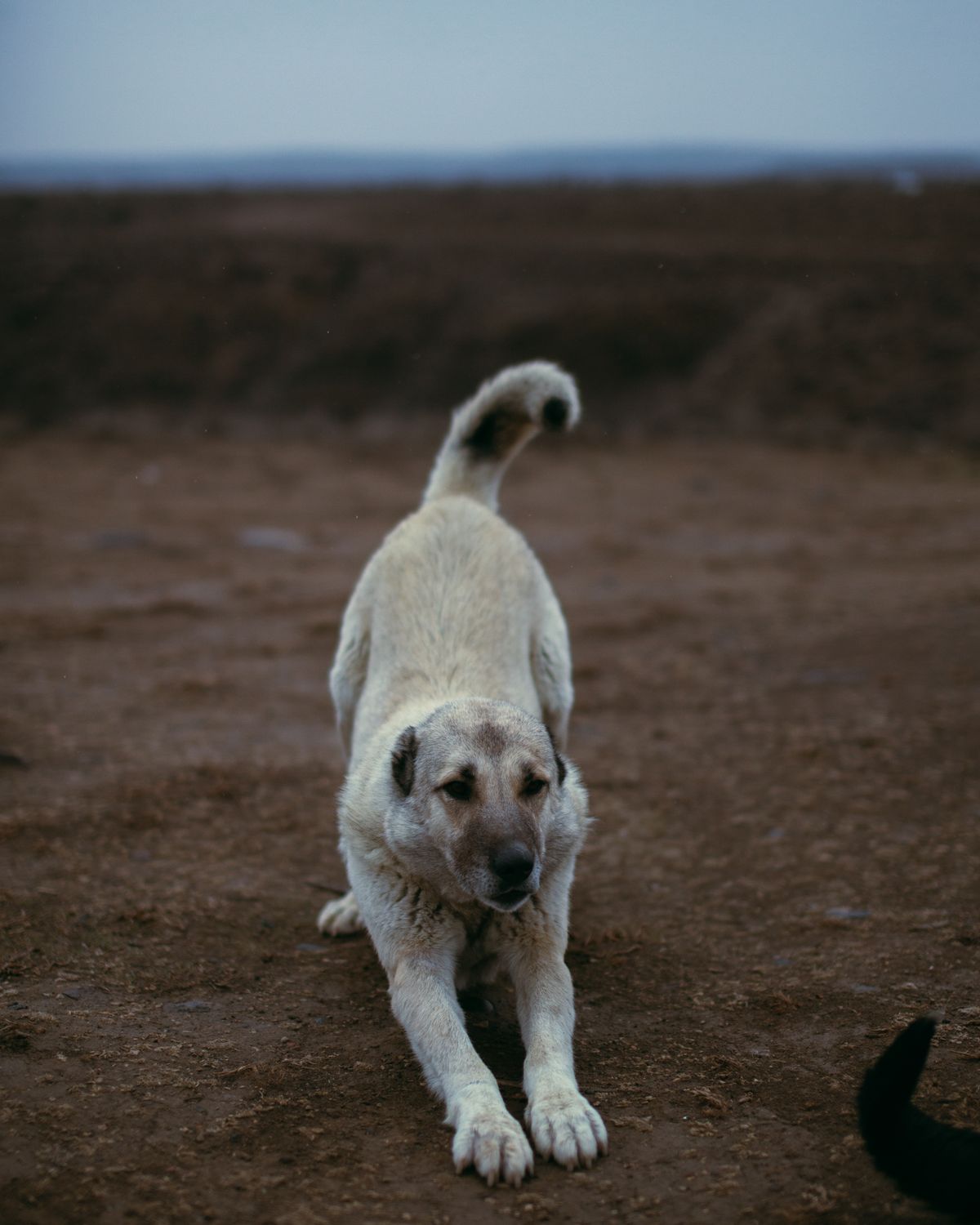
Your dog gets up as you enter, reaches forward, and raises their rear. A brief stretch during a greeting can be ordinary movement after resting, while a similar posture can also invite play. The shape alone does not tell you which. Watch the movements before and after it instead of assigning one meaning to every lowered chest.
Compare the whole sequence
A dog that has just woken may stretch, shake, and walk toward you. A dog that bounces away, returns, and makes loose playful movements may be inviting interaction. These patterns help you form a practical interpretation without claiming you can read an intention from a still photograph.
Try noting where your dog was before the greeting. If most stretches follow a nap, that context matters. If they appear during a game with pauses and bouncing, play is a more plausible reading.
A play bow is an invitation, not a command
Play bows commonly involve the front end lowered and the rear raised. A comfortable interaction should still leave both animals or people free to disengage. Do not assume another dog wants to join merely because yours bows.
Keep greetings with unfamiliar dogs controlled and give space when either becomes stiff or tries to move away. A playful-looking position is one clue in a larger exchange, not permission to let an interaction escalate.
Respond to the greeting your dog actually offers
For a relaxed stretch followed by a calm approach, a quiet greeting may be enough. If your dog seeks a game, offer a suitable toy or a short activity when you have time. You do not need to turn every return home into an energetic event.
If jumping follows, reward moments when paws remain on the floor. A consistent routine helps your dog learn which part of the greeting earns attention. Avoid pushing or scolding because the first posture looked enthusiastic.
Make an observation log
For a few days, record the time, whether the dog had been sleeping, how long the posture lasted, and what happened next. Keep a brief video that includes the lead-in and recovery. It is more useful than filming only the stretched pose.
Do not provoke repeated bows to collect data. Everyday voluntary movement provides enough information. You are looking for a stable routine or a change in comfort, not a trick performance.
When repeated stretching needs attention
A new or persistent posture accompanied by vomiting, restlessness, reduced appetite, or apparent abdominal pain deserves veterinary advice. A painful dog may adopt positions that resemble ordinary stretching, so do not dismiss other symptoms.
A swollen abdomen, unsuccessful attempts to vomit, collapse, or marked distress requires urgent veterinary care. Do not keep the dog exercising or wait for a video-perfect example before asking for help.
Frequently asked questions
Does a greeting stretch prove affection?
It can occur during a friendly greeting, but it is not a reliable measure of affection on its own.
Should I stretch my dog’s legs for them?
Do not manipulate joints to imitate the posture. Ask a veterinarian or qualified rehabilitation professional about any prescribed exercises.
Related Petzora guides
Sources and further reading
Written by Emon Ahmed for general education, not veterinary diagnosis or treatment.