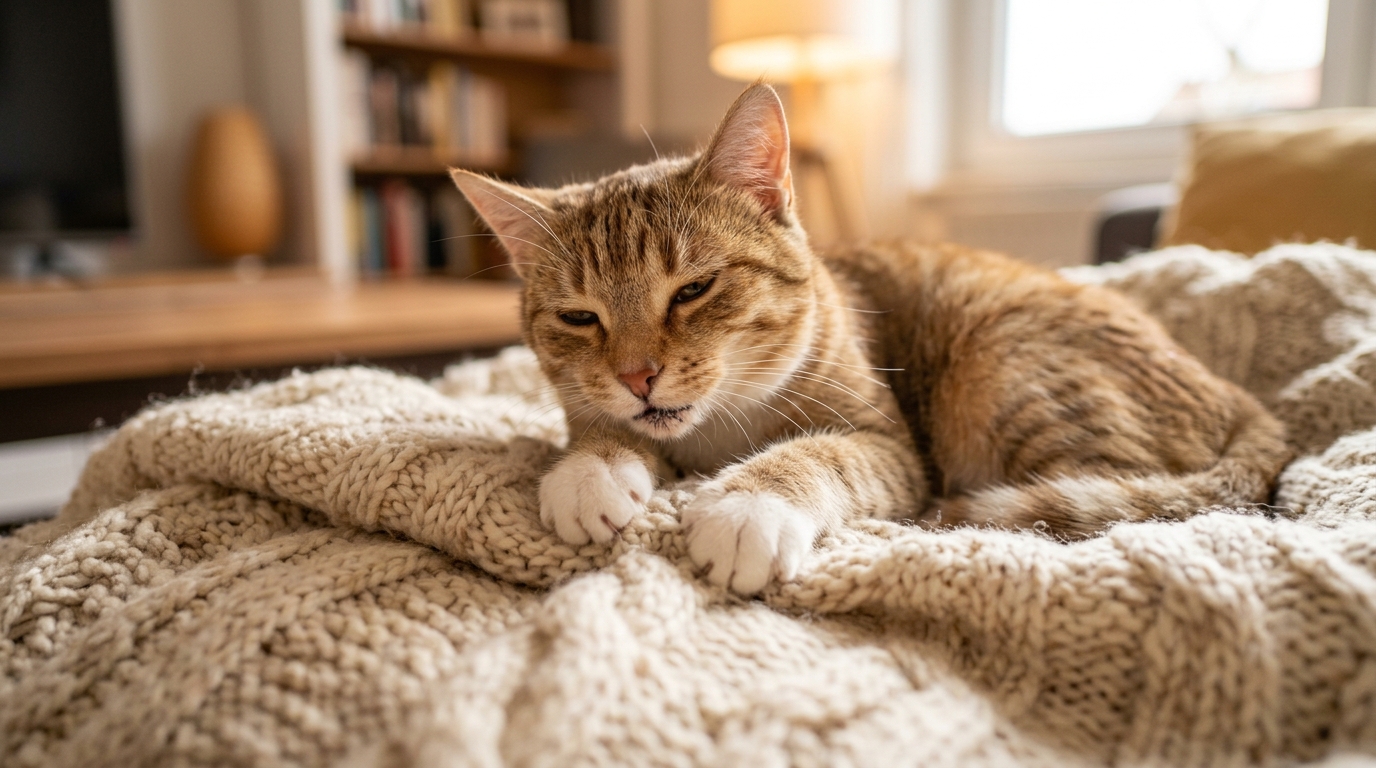
Kneading is the repeated pushing movement cats make with their front paws, often on a soft blanket or a person’s lap. It commonly happens while a cat is settling. Watch the rest of their body and the situation before deciding what the behavior means.
Whether your cat prefers kneading a thick fleece throw, a plush pet bed, or your own stomach, pet parents frequently wonder why do cats knead and what emotional state drives this persistent habit. Is it an instinctive declaration of love, a lingering childhood reflex, or a practical way of claiming territory? While veterinary researchers and certified feline behaviorists have analyzed feline body language for decades, kneading remains one of the most uniquely expressive, heartwarming, and widely observed behaviors in domestic cats.
Cats knead because the behavior originates in early kittenhood while nursing to stimulate milk flow and persists into adulthood as a deeply ingrained sign of comfort, relaxation, and emotional security. Adult cats also knead to deposit territorial pheromones from their paw pads, stretch flexor muscles, and prepare cozy resting spots before sleeping. Kneading is a healthy, completely normal feline instinct.
What Is Cat Kneading?
At its core, cat kneading is a rhythmic, repetitive motion where a cat alternates its front paws, pushing down and pulling back against a soft, pliable surface. To human observers, the steady cadence looks remarkably like a master baker methodically working a ball of bread dough—which is why the internet and feline communities popularized the endearing phrase cat making biscuits.
During an active kneading session, several distinct physiological and behavioral actions occur simultaneously:
- Alternating Forelimb Stepping: The cat shifts its body weight smoothly between left and right front legs in a rhythmic, quasi-hypnotic tempo. Some cats also engage their hind feet, performing a subtle four-paw "tread."
- Claw Extension and Retraction: As each paw presses downward, the digital flexor tendons tighten, causing the claws to spread and extend outward. As the paw lifts, elastic ligaments pull the claws safely back into their sheaths.
- Rhythmic Purring: The laryngeal muscles vibrate in sync with the paw movements, signaling active parasympathetic nervous system engagement.
- Softening Facial Posture: The cat’s eyes typically become heavy-lidded or half-shut, with whiskers resting flat and relaxed against the cheeks.
- Occasional Hypersalivation (Drooling): In deeply relaxed cats, involuntary salivary flow increases, resulting in clear moisture pooling around the mouth.
Why Do Cats Knead? 8 Common Reasons
Feline behavior researchers generally agree that kneading serves several distinct biological and psychological functions across a cat’s lifespan. Rather than possessing a single solitary trigger, a cat may knead for different reasons depending on its physical environment, age, hormonal status, and emotional comfort level.
1. It Starts During Kittenhood as a Nursing Reflex
The biological origin of kneading begins within hours of birth. Newborn kittens are born blind and deaf, relying almost exclusively on tactile cues, thermal warmth, and maternal scents to navigate toward their mother’s abdomen. As kittens nurse, they instinctively press their tiny front paws rhythmically around the mother’s mammary glands. This action stimulates oxytocin release, prompting the milk letdown reflex while creating an enduring neurological association between kneading, warmth, safety, and nutritional security.
2. Kneading Helps Cats Feel Comfortable and Relaxed
Just as human adults might wrap themselves in a warm weighted blanket or drink chamomile tea to decompress, cats utilize kneading as an active self-soothing ritual. Neurochemical research suggests that rhythmic motor patterns stimulate the release of endorphins in the feline brain, producing a mild, tranquilizing sensation of well-being right before settling into deep, restorative sleep.
3. Your Cat May Be Showing Affection and Vulnerability
4. Cats May Knead to Mark Their Territory With Scent Glands
Cats are intensely olfactory animals whose daily perception of the world is largely governed by scent cues. Microscopic sebaceous scent glands nestled between the digital pads on the underside of their paws—known as interdigital glands—deposit chemical markers (pheromones) whenever a cat presses its paws against a surface. By kneading a blanket, cushion, or sweater, your cat leaves an invisible scent signature that signals familiar, secure territory.
5. Cats May Be Preparing a Comfortable Sleeping Spot
Long before domestic felines enjoyed plush cat beds, wild ancestors such as the African wildcat (Felis lybica) survived in open savannas and scrublands. In wild environments, rhythmic stepping trampled and flattened tall grass and dry twigs into a softer nesting hollow, flushed out hidden insects or snakes, and created an ergonomic depression sheltered from prevailing winds.
6. Kneading Can Be Part of Musculoskeletal Stretching
Cats maintain remarkable joint mobility and muscle tone through frequent stretching. Kneading provides a low-impact workout that elongates the deep digital flexor tendons and engages the triceps, pectoral muscles, and latissimus dorsi across the shoulders and spine, restoring blood circulation after hours of curled-up sleep.
7. Some Cats Knead When Experiencing Anxiety or Stress
While kneading is overwhelmingly a manifestation of contentment, it can occasionally serve as a displacement activity when a cat feels unsettled. Major household disruptions—such as moving homes, adopting a new pet, or remodeling—may prompt a cat to seek self-regulation through intense, repetitive motor rituals to artificially induce feelings of safety.
8. Hormones Can Influence Kneading in Unspayed Female Cats
In intact (unspayed) female cats, kneading can be directly tied to reproductive biology. During the estrous cycle, elevated estrogen triggers a low-crouched mating posture (lordosis) where the cat raises her hindquarters, vocalizes in a throaty yowling tone, and treads the floor rapidly with both front and back paws. Once spayed, this hormonally driven mating treading ceases entirely.
Why Does My Cat Knead Me?
Having a cat choose your lap or chest over plush furniture is a uniquely gratifying experience. When owners ask why does my cat knead me, animal behaviorists point to a blend of warmth, anatomical give, and scent exchange:
- Radiant Body Heat: Human core body temperature (around 98.6°F / 37°C) mimics maternal warmth, which cats instinctively seek out for comfort.
- Pliable Texture: The soft give of a relaxed human thigh or chest offers ideal physical resistance for a cat’s digital flexor muscles.
- Reciprocal Scent Exchange: Your natural scent represents total security. Kneading your body allows the cat to absorb your scent while depositing its own calming pheromones onto your clothes.
- Affiliative Social Bonding: Bonded cats engage in mutual grooming (allogrooming) and head-rubbing (allorubbing). Kneading an owner is an equivalent marker of secure feline attachment.
Why Do Cats Knead Blankets?
If you have ever observed your cat passionately working its paws into a plush fleece throw, you may wonder why do cats knead blankets with such singular focus. Modern synthetic textiles—such as sherpa, high-pile plush, faux fur, and brushed microfiber—possess a textural density that feels remarkably similar to a mother cat’s dense fur coat. Stepping onto these materials activates mechanoreceptors in feline paw pads that trigger an involuntary sensory flashback to early kittenhood.
Why Do Cats Purr While Kneading?
Kneading and purring co-evolved as essential kitten survival behaviors. Because newborn kittens cannot nurse and meow simultaneously, they purr while suckling to communicate to the queen that milk is flowing and that they are safe. In adult cats, the neural circuitry linking tactile paw stimulation with laryngeal vibration remains intact, producing a simultaneous expression of deep relaxation.
Why Does My Cat Knead and Bite a Blanket?
Some cats go beyond pawing by taking a fold of a fleece blanket into their mouth, biting down gently or suckling while kneading rhythmically. Known as "wool sucking," this habit is particularly prevalent in kittens separated from their mother before eight to ten weeks of age or in oriental breeds such as Siamese and Tonkinese.
While gently mouthing or suckling a fleece blanket is generally harmless, actual chewing, tearing, or ingestion of fabric fibers is a medical condition known as pica. Ingested fibers can cause life-threatening gastrointestinal foreign body obstructions. If your cat swallows threads or fabric pieces, consult your veterinarian promptly.
Why Do Some Cats Drool While Kneading?
When a cat reaches a profound state of comfort, its parasympathetic nervous system (the "rest-and-digest" branch) takes full control. Heart rate slows, muscles relax completely, and salivary gland secretion increases. In addition, the psychological anticipation of nursing—ingrained from kittenhood—primes the salivary pathways in anticipation of milk. The cat simply forgets to swallow while lost in the comforting reverie.
Do All Cats Knead?
No. Feline personalities vary dramatically. Some cats knead daily on every available soft surface; others knead only when perched on one specific family member's lap; and a noticeable percentage of cats rarely or never knead at all. If your cat never makes biscuits, this is not an indication that it lacks affection—cats express comfort through slow-blinking, head-bunting, exposing their belly, and following you from room to room.
How to Stop Cat Kneading From Hurting You
The sharp needle-like claws of an enthusiastic cat can turn a sweet bonding session into an uncomfortable ordeal. You can protect your skin without discouraging your cat's natural affection through three humane management strategies:
1. Keep a Dedicated "Lap Blanket" Nearby
Store a thick, folded fleece or sherpa throw near your sofa. Whenever your cat approaches with that determined biscuit-making look, slip the blanket across your lap before it begins. The dense fibers stop claws from puncturing skin while providing the plush texture cats love.
2. Maintain Regular Claw Trims Every 2-3 Weeks
Trimming just the razor-sharp transparent tips of your cat's front claws prevents accidental punctures. Take care to avoid the pink "quick" (blood vessel) and reward your cat with treats to maintain a positive association.
3. Gently Redirect to an Adjacent Pillow
If your cat starts kneading an unprotected area, gently lift the cat with two hands and place it onto a soft pillow beside you while continuing to stroke its back. Never yell, swat, or push the cat away—punishment will only erode your bond and cause confusion over an instinctive behavior.
Declawing (onychectomy) is never an acceptable solution for managing claws during kneading. Declawing is a surgical amputation of the last bone of each toe, leading to chronic phantom pain, arthritis, and behavioral issues. Humane nail maintenance and lap blankets are safe, effective, and endorsed by veterinary organizations worldwide.
Frequently Asked Questions About Cat Kneading
Q: Why do cats knead their owners?
Cats knead their owners as an expression of profound emotional security, affection, and comfort. Because kneading originates in kittenhood as a nursing behavior associated with maternal warmth, directing it toward you signals that your cat views you as a trusted caregiver. Additionally, interdigital scent glands in your cat's paws transfer familiar pheromones onto you, strengthening your social bond.
Q: Why do cats knead blankets?
Plush, textured blankets like microfiber, fleece, and sherpa mimic the tactile feel and warmth of a mother cat's belly. When an adult cat kneads these soft surfaces, it triggers a pleasurable, self-soothing sensory reflex that promotes relaxation, eases muscular tension, and prepares the bedding for a peaceful nap.
Q: Why do cats purr while kneading?
Purring and kneading naturally coincide because both behaviors co-evolved during nursing. Newborn kittens purr to indicate to their mother that milk is flowing and that they are safe. In adult cats, the pair of behaviors signifies peak parasympathetic relaxation and emotional contentment.
Q: Why does my cat knead me but not other people?
Cats are selective with physical vulnerability and bond most intensely with the individual who provides consistent care, gentle handling, and a predictable environment. If your cat kneads you exclusively, it indicates a high level of individual trust and secure attachment that other household members have not yet cultivated.
Q: Why does my cat knead before sleeping?
Kneading before sleep helps a cat settle both mentally and physically. The rhythmic pawing contours bedding into an ergonomic nest, gently stretches limb muscles after waking or lounging, and deposits calming territorial pheromones so the cat can sleep with complete peace of mind.
Q: Is cat kneading a sign of happiness?
In almost every circumstance, yes. When accompanied by soft facial features, a gentle purr, relaxed whiskers, and slow breathing, kneading is one of the most reliable visual indicators of feline happiness and tranquility.
Q: Should I stop my cat from kneading?
No. Kneading is an innate, healthy behavior that provides genuine psychological benefits. Rather than attempting to stop your cat, manage sharp claws with routine nail trims and keep a thick blanket over your lap so you both enjoy the cuddle session comfortably.
Q: Why does my cat knead with claws out?
A cat's claws are mechanically linked to the digital flexor tendons in the paw. When the paw presses downward, the tendon tightens, naturally extending the claw tips. As the paw lifts, the claw retracts. Your cat is not attempting to scratch you intentionally—it is simply how feline paws function biomechanically.
Related cat behavior: If your cat also shadows you from room to room, read Why Does My Cat Follow Me Everywhere? 12 Reasons and What It Means.
Read the context, not a single signal
Behavior does not give a direct measurement of a pet’s emotions. Look at the situation and several signals together, allow the animal to move away, and avoid forcing interaction. Sudden changes or distress need appropriate veterinary or qualified behavior advice.